
GLIMS Journal of Management Review and Transformation

 Search
S. Vinoth Kumar1 and D. Unika1
1Department of Commerce, Patrician College of Arts and Science (Affiliated to the University of Madras), Chennai, Tamil Nadu, India

Creative Commons Non Commercial CC BY-NC: This article is distributed under the terms of the Creative Commons Attribution-NonCommercial 4.0 License (http://www.creativecommons.org/licenses/by-nc/4.0/) which permits non-Commercial use, reproduction and distribution of the work without further permission provided the original work is attributed.
The current study offers a thorough bibliometric analysis on the topic of the link between Foreign Direct Investment (FDI) and sustainable development, with publications included from 1992 until 2024. In total, 552 publications have been analysed through the application of performance analysis methods and bibliographic coupling. The findings suggest an increasing number of publications (NPs), especially since 2015, with the highest level achieved in 2023. In terms of the most productive countries, China leads the ranking, while Malaysia and Pakistan follow suit. With regard to journals, Sustainability becomes a top producer and citable source at once. Thematic clusters identified by the study include topics such as green growth, environmental sustainability, and economic development. Overall, the research demonstrates several collaboration networks and trends that characterise contemporary research. Thus, the presented article makes an important contribution to the identification of the current dynamics of research around the FDI–sustainability relationship.
Foreign Direct Investment (FDI), sustainability, sustainable development, bibliometrics analysis thematic analysis, future research directions
Introduction
Foreign Direct Investment (FDI) is widely acknowledged as an essential factor that stimulates economic growth and development, especially in developing countries, where local investment and technology may be scarce (Alabdalrahman et al., 2023; Oliveira & Santos, 2023). Lately, however, the focus of interest related to FDI has shifted from purely economic considerations to how FDI may contribute to sustainable development, including protection of the environment, promotion of social equity, and economic sustainability (Rodríguez-Chávez et al., 2024). The need to pursue sustainable development, especially against the backdrop of the UN Sustainable Development Goals (SDGs), has become increasingly evident (Akanle et al., 2022).
The impact of FDI on many of the SDGs is quite positive, including goals such as SDG 8 (Decent Work and Economic Growth), SDG 9 (Industry, Innovation, and Infrastructure), and SDG 13 (Climate Action), because FDI can bring about capital inflows, industrial growth, and technology transfers (UNCTAD, 2023). Nonetheless, there is no clear link between FDI and sustainability. In some cases, FDI can be conducive to adopting environmentally friendly production techniques and enhancing environmental productivity, which is known as the ‘pollution halo’. In other instances, however, FDI can be responsible for pollution in a country because it invests in pollution-intensive industries where regulations are lax, according to the ‘pollution haven’ hypothesis.
Although empirical evidence on the relationship between FDI and sustainability is rapidly expanding, existing research on this topic generally concentrates on certain aspects of this phenomenon, such as the influence of FDI on the environment, economy, and society. In addition, there are no studies that attempt to synthesise the knowledge gained on the topic and analyse the intellectual development and structure of this scientific area over time. Bibliometric analysis serves as an effective tool in analysing scientific progress and providing information about its dynamics through mapping of knowledge, identification of its influential works, and revealing key themes in the field (Donthu et al., 2021).
The current study will fill in the gap in scholarly research by means of performing a bibliometric analysis of the existing literature on FDI and sustainable development from 1992 to 2024. It will examine trends of publications in the field, find out the main contributors to the area, and explore the intellectual structure of the research topic by using a range of bibliometric tools. Therefore, the originality of this article will consist in combining performance analysis and scientific mapping of literature on FDI and sustainable development.
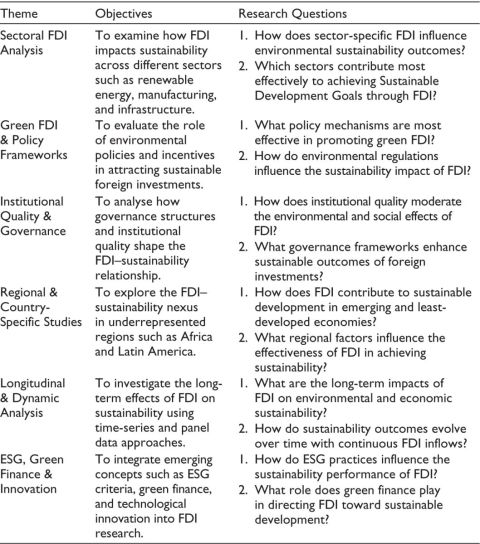
To address the identified research gap, this study aims to achieve the following objectives:
Theoretical Background
The interconnections between FDI and sustainable development have garnered much attention in academic circles over the last few decades, given the significance accorded to linking economic development with environmental and social goals (Dunning & Pitelis, 2010). The body of research carried out by scholars in relation to this subject matter can primarily be classified into three areas, namely: (a) FDI and environmental sustainability, (b) FDI and economic development, and (c) bibliometrics and reviews of FDI and sustainability.
Literature strand one centres around the impacts of FDI on the environment in relation to issues such as carbon emissions, ecological footprints, and natural resource consumption. Numerous empirical pieces of evidence have sought to determine whether FDI leads to environmental deterioration or improvements (Ehigiamusoe et al., 2023). For example, Piabuo et al. (2023) examine the effect of FDI on carbon emissions associated with changes in land use and forestry operations. In addition, Tsoy and Heshmati (2024) examine the effect of FDI inflows on environmental sustainability while paying attention to how the relationship is influenced by institutional quality. Research studies on the issue of FDI and the environment may adopt one of two opposing theories: The pollution haven hypothesis, according to which foreign firms prefer to move to countries with relaxed environmental regulations due to lower costs, or the pollution halo hypothesis, which posits that FDI can be positive for the environment.
The second thread is concerned with the effects of FDI on economic growth and development. FDI is viewed as an important contributor to capital formation, technology adoption, and efficiency improvements in many countries, especially those still developing economically (Oliveira & Santos, 2023; Pan et al., 2023). The works of Izadi and Madirimov (2023) on the relationship between FDI and SDGs illustrate the potential contribution of FDI in economic development under the right policy environment. Also, (Jayakumar, 2013; Liou et al., 2023; Rodríguez-Chávez et al., 2024) emphasise the multidimensional nature of sustainable development and point out that while FDI can foster economic development, its impacts may go beyond economic dimensions and include social and environmental dimensions as well.
The third strand involves review and bibliometric studies that aim at synthesising the increasing literature on FDI and sustainability. Bitzenis and Koutsoupias (2023) present a bibliometric review through a visualised representation, mainly concentrating on green sustainability. In a similar way, Rodríguez-Chávez et al. (2024) examine a bibliometric study of FDI and sustainable development in Asia. These pieces of literature make contributions to knowledge on certain parts of the topic, but they are mostly narrow in their coverage, whether geographical or thematic. Moreover, most reviews tend to concentrate on environmental issues, overlooking those integrating all three components of sustainability—economic, environmental, and social over time.
However, despite the above-mentioned contributions, some gaps still need to be filled in the literature. First, there is a lack of systematic and multidimensional bibliometric analysis covering the entire timeline of evolution of FDI–sustainability studies at a global level. Second, the majority of existing articles focus on the short-term and local aspects, thus making their generalizability rather questionable. Third, there is a need for integration between theories and empirical results, as well as the identification of emerging trends in the area under investigation.
The present research makes significant contributions to society by establishing determinants and emerging research themes within the FDI-sustainable development relationship. Through identifying global research trends, the current research contributes to informing policymakers on how they could develop appropriate strategies to ensure that foreign investments are sustainable and eco-friendly. In addition, it helps international agencies identify ways through which investments can be made in alignment with SDGs, especially within developing nations. Finally, the findings from this study will contribute to emerging themes in green growth and development.
Thus, in order to fill the identified gaps, the current article aims to conduct an extensive bibliometric study that will help understand the state-of-the-art and future directions of research related to the topic in question. In this regard, the present study will contribute to the existing body of knowledge by providing a thorough bibliometric analysis of FDI and sustainable development research between 1992 and 2024.
Methodology
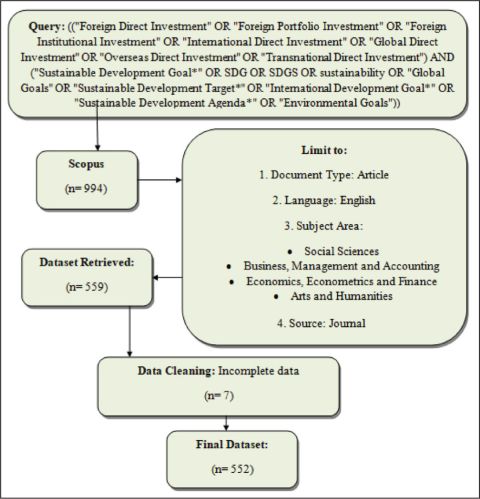
This bibliometric study uses bibliometric tools to analyse the existing body of literature regarding FDI and sustainable development. Bibliometric analysis refers to a quantitative assessment of academic literature using publication trends, collaboration networks, and thematic structure in a scientific domain (Glänzel & Schubert, 2005; Donthu et al., 2021). It is an appropriate tool when it comes to processing the large amounts of data associated with a certain research area. A bibliographic search was performed using the Scopus database, known for its extensive collection of academic publications. Search filters were applied by searching for a set of selected words related to the FDI and sustainable development in titles, abstracts, and keywords. Specifically, the keywords and word phrases ‘Foreign Direct Investment’, ‘FDI’, ‘sustainable development’, ‘sustainability’, and ‘SDGs’ were employed.
The search resulted in a total of 994 documents. These documents were filtered to exclude those that were written in languages other than English, duplicates, conference papers, book chapters, and all types of documents not pertaining to academic research. Eventually, the data sample comprised 552 articles (Figure 1).
Figure 1. Article Selection Process.
Results and Discussion
General Characteristics of the Bibliometrics Analysis
Table 1 presents descriptive statistics that offer a preliminary description of the structural features of the analysed bibliometric dataset. The bibliometric sample consists of 552 papers published from 1992 to 2024 and is based on a wide range of sources, namely, 240 sources, mainly scientific journals. Such a wide variety of sources implies that studies concerning FDI and sustainable development are distributed broadly, since the research topic is interdisciplinary. The annual increase in the number of articles published is characterised by a growth rate of 14.81%. The positive dynamics observed prove the existence of a strong academic interest in examining how the topic of FDI contributes to meeting SDGs. Importantly, the number of publications (NPs) has been steadily increasing in the period after 2015 due to the implementation of new sustainability models such as SDGs worldwide.
Table 1. Main Information by RStudio.
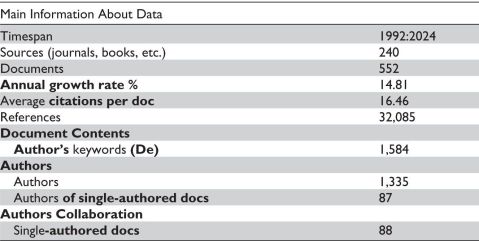
References in the dataset amount to a total number of 32,085, suggesting the development of an extensively developed knowledge base with a considerable accumulation of findings. In addition, a high number of references points to a highly developed scientific literature on the topic with strong theoretical and empirical foundations necessary for the continuation of research. Moreover, the average citation per document value equals 16.46, demonstrating a rather strong impact of the papers from this particular database and their contribution to the academic community’s discourse. Regarding the number of authors involved in the investigation, it is possible to state that there are 1,335 authors represented in this dataset. Such a great number of people participating in this research proves the high diversity and richness of the research community interested in the study of FDI and sustainability. Moreover, there is a high percentage of collaborative work among the authors, with the total number of documents produced by one author constituting 88 documents, while multi-authored papers have a significantly higher number.
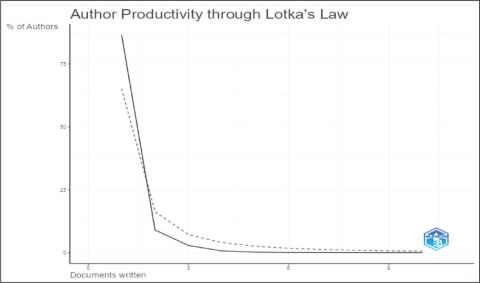
The analysis of author productivity, based on the data shown in Table 2 and Figure 2, uses the theoretical basis of Lotka’s law, according to which a high number of authors publish only once, whereas a low number of authors publish several times. These findings fully correspond to the given hypothesis. Almost all authors (1,155 out of 1,335, or approximately 86.5%) have published only one paper in the domain. At the same time, the number of authors falls significantly as the number of their publications grows, and only a small number of authors have published several papers. For example, only 10 authors have published four papers, and only one has written 10 papers.
Table 2. The Number of Articles and Frequency Are Based on Lotka’s Law Using RStudio.
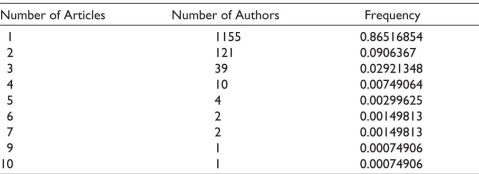
Figure 2. Annual Scientific Production.
Source: RStudio results.
It should be noted that the graphic depiction emphasises this conclusion. The empirical curve (the solid line) closely coincides with the theoretical Lotka curve (the dashed line). It proves that the actual distribution of author productivity corresponds to the theoretical one and shows the presence of typical scientific productivity structures for the studied field. In other words, the knowledge generation in the area under consideration is provided by several active specialists, while other participants take part in research rarely. In addition, the parameters of the regression model (c = 0.614 and R2 = 0.91) reveal the high level of fit between the actual data and the theoretical Lotka distribution. Besides, the value of the p value, which was obtained from the Kolmogorov–Smirnov goodness-of-fit test (0.54), allows rejecting the null hypothesis and stating that the real author productivity distribution corresponds to Lotka’s law.
It seems reasonable to interpret these results from a developmental perspective. The predominance of single-publication scholars demonstrates that the scientific area under consideration continues to develop and attracts new scholars, who join research only occasionally. However, the presence of active scientists shows the formation of the field cores, which determine its intellectual framework and further development directions.
The most productive and highly-cited journals in the literature on FDI and sustainable development are highlighted in Table 3. Multiple indicators used for bibliometric analysis, such as the h-index, g-index, m-index, total citations (TC), and NP, have been used for the assessment. According to Table 3, the journal Sustainability (Switzerland) is among the most prolific sources in the current literature, since the publication features a high number of published articles (81), as well as numerous citations (1,211). The h-index (19) and g-index (32) demonstrate the considerable influence of the journal, implying that Sustainability becomes an important channel for distributing research on the relationship between FDI and sustainable development.
Table 3. Journal Classification Is Based on Its Impact.
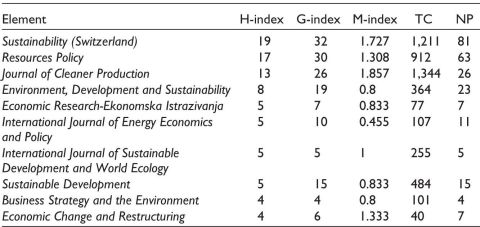
Conversely, Journal of Cleaner Production shows the highest TCs (1,344), despite the low publication record of this journal (26). This implies that the articles appearing in this journal receive more citations per article, thereby demonstrating the high quality and reputation of the journal. The relatively high m-index of the journal (1.857) also confirms its long-term contribution and significance to producing high-quality research articles related to the subject. As for the Resources Policy, this journal has a high publication index (63), a good number of TCs (912), and an impressive h-index (17). Such figures make it possible to conclude about the essential role of this journal in studying the relationship between natural resources, economic policies, and investments in sustainable development, which makes this journal significant for analysing FDI. At the same time, the journals Environment, Development and Sustainability and Sustainable Development contribute significantly to the research domain, but with somewhat smaller impact indexes. This fact testifies to the growth of journal variety in relation to sustainability-oriented themes. Business Strategy and the Environment, Economic Change and Restructuring can be considered among journals that integrate environmental themes in their titles.
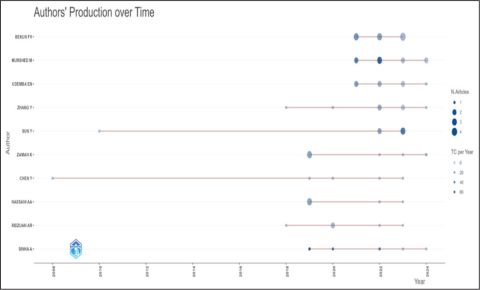
As shown in Figure 3, the timeline of publications for the top productive scholars on the topic of FDI and sustainable development indicates both publication frequency and citation impact on the timeline of each author’s contributions. From the findings, it can be seen that only a few scholars have exhibited consistent research contributions, such as Bekun F.V., Murshed M., and Udemba E.N., among others, especially in the latter timeline starting from 2019. The increased contributions from the identified scholars coincide with the observed growth in publications within the studied sample in the later years. Therefore, it is clear that the top productive scholars have played a major role in influencing the recent growth in publications. Notably, the identified scholars show consistent contributions in consecutive years, implying active engagement and specialisation in the area of research. On the other hand, some authors show a prolonged period of involvement in the area, but with periodic contributions. For instance, Chen Y. and Sun Y. have made contributions to publications over a long period of time, but with gaps in between. The size and darkness of the nodes, depicting the number of articles published and their cumulative citations annually, denote varying impacts of these authors on academics. Larger and darker nodes refer to those authors who have been writing papers that have been extensively cited, thus demonstrating not only a high level of output but also its significance for the field’s development. It is indicative of key opinion leaders in the area whose works strongly influence further research. A striking characteristic of authors’ activities since 2020 is a pronounced clustering tendency. This phenomenon stems from the increasing importance of sustainability studies worldwide in light of implementing the SDGs and promoting more sustainable investing. It indicates that the field keeps developing dynamically with new players joining in and others boosting their efforts in the matter.
Figure 3. The Authors’ Productiveness.
Source: RStudio results.
Countries
In Table 4, the distribution of scientific production by countries in terms of the corresponding author, as well as SCPs and MCPs of those countries, can be observed. Such an analysis allows us to understand more about both the domestic research and international collaboration concerning the topics of FDI and sustainable development. According to the results of the analysis, we can conclude that China is the leader of this field of science, publishing a significant NPs—148—compared to other countries. Moreover, it can be observed that SCPs in China are slightly higher than MCPs, which indicates a high quality of both domestic research activities and international cooperation in the sphere.
Table 4. Corresponding Authors’ Countries and Scientific Production.
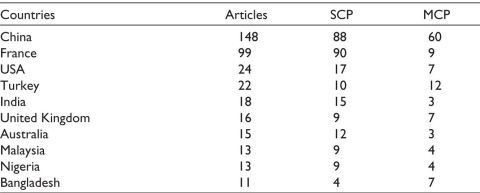
Coming in at second place is France with 99 publications. However, the contributions of France appear more domestic, with more SCP (90 SCP) than MCP (9 MCP) publications. This suggests that although there is considerable research going on domestically, there appears to be less internationalisation, which makes the research output of China more diverse. Countries like Turkey and Bangladesh have more MCP than SCP publications, indicating a greater degree of international cooperation within their research communities. Countries like the US, UK, and Australia have roughly equal numbers of SCP and MCP publications, indicating the presence of a well-established research community and an active role in international collaborations. Countries like these play an important part in the establishment of collaborations within the field. Other developing nations that contribute substantially to the literature include India, Malaysia, Nigeria, and Bangladesh. The participation of these countries is noteworthy as the topic of FDI and sustainability is increasingly becoming a global concern, especially for countries like theirs, which are impacted by FDI and sustainability issues.
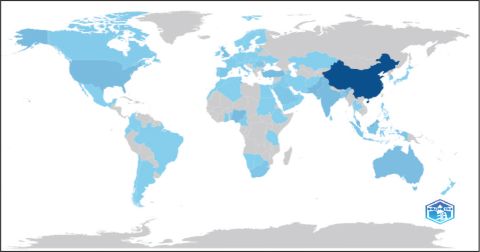
As seen from Figure 4, the world distribution of scientific production in relation to the FDI and sustainable development illustrates the concentration of research in certain areas. It should be noted that colour intensity indicates different research productivity, with dark colours denoting high productivity and light colour—low productivity. As follows from the map, the geographic location of research activity is quite concentrated in certain areas, and China appears to be the leader in terms of research in this area. Its prominent position as the darkest coloured area in the map confirms the results of Table 4, which implies China’s high interest in FDI and sustainability issues. It is mainly due to China’s crucial role in global investments and the country’s emphasis on sustainable development. Besides China, there are also research contributions from several European and North American countries and Asian countries, such as France, the USA, the UK, Australia, among others, which are characterised by high scientific production in relation to sustainability issues. There are quite obvious reasons for that.
Figure 4. Scientific Production by Country.
Source: RStudio re0sults.
First, these countries have a well-developed infrastructure for research. Second, they have high academic networking. Moreover, emerging economies such as India, Turkey, Malaysia, Nigeria, and Bangladesh are also seen to make contributions to the map, albeit in smaller numbers. Though the numbers for their contributions may not be high compared to the other countries, it shows the increasing interest of the international community in the area of FDI and sustainability, especially in developing countries that are directly affected by these two issues. On the other hand, there are a number of regions that have lower contributions to the research on FDI and sustainability, such as some African and Latin American nations.
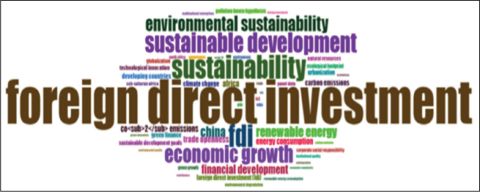
Figure 5 shows a visual representation through a word cloud of the most common keywords in the FDI and sustainable development literature. The size of the terms indicates their frequency of use; the bigger the word, the more prominent it is in the dataset. Among the terms shown, the most prevalent keyword in the word cloud is the phrase ‘Foreign Direct Investment’. It is noticeably bigger than all other keywords, indicating that FDI remains the focus of the literature and acts as the focal point from which all other concepts are derived. Other terms related to FDI include ‘sustainability’ and ‘sustainable development’, which also dominate the word cloud, suggesting that literature in this field takes an economic and sustainable development approach.
Figure 5. Word Map of Keywords.
Source: RStudio results.
At the same time, environmental issues are also well represented by such keywords as ‘environmental sustainability’, ‘carbon emissions’, ‘renewable energy’, and ‘climate change’. The appearance of such keywords shows the growing interest of scholars in the environmental aspect of FDI, specifically in such topics as emissions and energy consumption. This is consistent with the general trend towards inclusion of environmental aspects in the economic studies of foreign investments. The geographical and contextual keywords, including ‘China’ and ‘developing countries’, are also found in the visualisation, meaning that many scholars are interested in conducting their research in the context of emerging markets where FDI becomes an essential part of the development process. Such findings correspond to the earlier discussion on the leading role of such countries as China, both in FDI research and practice.
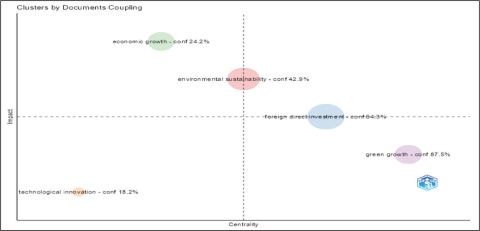
The thematic network of literature shown in Figure 6 is created according to the bibliographic coupling of keywords used by the author in the course of research and is plotted in the coordinates of centrality and impact/density. Thus, centrality represents the importance of the topic for the research field in general, and density reflects the level of the topic’s development or its cohesion. Based on the analysis of the network, there are five separate thematic clusters: FDI, green growth, environmental sustainability, economic growth, and technological innovation. Different positions on the plot show how important and developed the topic in question is within the context of the FDI and sustainability literature. The cluster ‘Foreign Direct Investment’ is located in the right-central part of the map; hence, it is highly central but not very dense. That means that FDI is an important topic which integrates other topics into itself, but is yet in the process of theoretical and empirical development. High centrality implies that it constitutes the backbone of the research field.
Figure 6. Cluster Coupling Is Evaluated by the Authors’ Keywords.
Source: RStudio results.
The ‘environmental sustainability’ group is found close to the centre, with high density and moderate centrality. This means that even though the group is very well-developed in its contents, it is still less related to other groups than core themes such as FDI and green growth are. Still, the fact that this group is so prominent in the diagram indicates its relevance and importance to the literature. On the other hand, the ‘economic growth’ group belongs to the upper left quadrant, meaning high density and low centrality. Therefore, economic growth can be seen as a mature topic for research, but one which is losing its centrality as time passes and the focus on sustainability increases. This represents another shift in the direction of research towards sustainability instead of economic growth as its goal. Lastly, the ‘technological innovation’ group occupies the lower left quadrant, showing low centrality and low density.
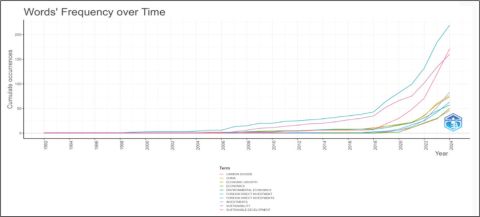
Figure 7 demonstrates the timeline of the evolution of crucial research terms used in studying the interrelationships between FDI and sustainable development. It reflects the dynamics of the frequency with which certain terms were used, helping us understand how research priorities and the scope of discussion changed at different times.
Figure 7. Keywords: Dendrogram Using a Hierarchical Clustering Method.
Source: RStudio results.
According to Figure 7, such core terms as ‘Foreign Direct Investment’, ‘sustainability’, and ‘sustainable development’ have seen a remarkable increase in usage, especially starting from 2015. Such dynamics may be explained by the implementation of the SDGs, which increased researchers’ interest in sustainability and its related topics. At the same time, the term ‘Foreign Direct Investment’ demonstrates the highest growth, thereby proving its key importance for studies on sustainable development. Apart from the aforementioned core terms, such keywords as ‘economic growth’ and ‘financial development’ demonstrate positive trends in their use. The fact speaks about the persistence of the importance of the traditional economic approach to FDI studies; however, its dynamics are not as strong as those of the terms related to sustainability.
Environmental words such as ‘carbon dioxide’, ‘environmental economics’, and ‘climate change’ have witnessed significant increases lately, particularly after 2018. Such an occurrence shows the increasing worry of researchers concerning the effects of FDI on the environment and the necessity of directing investments towards climate and sustainability goals. This development suggests that research is moving from an economic perspective to one that focuses on the environment. Interdisciplinary links have been evident from the co-occurrence of words associated with economics, environment, and sustainability.
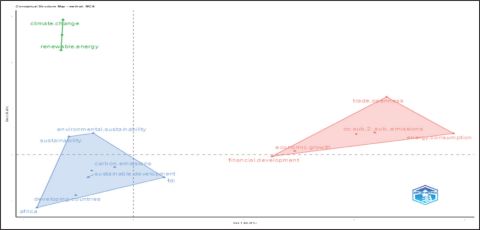
Figure 8 illustrates the structure of the research field according to the results of MCA, showing the clusters of keywords that occur together. This type of visualisation is used to explore the intellectual structure and the relationship between the identified concepts within the body of knowledge on FDI and sustainable development. The map shows that there are two main clusters that include a set of interrelated but distinctive research streams. The first cluster, shown in blue colour, consists of the following keywords: ‘sustainability’, ‘sustainable development’, ‘environmental sustainability’, ‘carbon emissions’, ‘FDI’, and ‘developing countries’. It can be seen that the research stream represented by these keywords revolves around the topic of sustainability, including such issues as sustainable development, carbon emissions, and economic development. It should also be noted that this research stream pays considerable attention to FDI, as well as its impact on Africa and developing countries.
Figure 8. Conceptual Structural Map.
Source: RStudio results.
The other stream is depicted in red and contains the following set of keywords: ‘economic growth’, ‘financial development’, ‘trade openness’, ‘energy consumption’, and ‘CO2 emissions’. It should be noted that this research stream is mainly focused on economics. The distance between the two clusters signifies some level of distinction in the concepts behind sustainability-based research papers and economic growth-based papers. However, the fact that similar keywords such as ‘CO2 emissions’ and ‘FDI’ are found in both streams means that these two research areas are not isolated but are converging with time. This fact shows that there is no conflict between economic growth and sustainability, as both concepts are intertwined. One additional fact about these two clusters is that the sustainability research stream is more compact compared to the economic research stream. This may show that there are commonalities among the concepts used in the sustainable research, while there are more divergences among the themes of economic research papers.
Future Research Agendas
Limitations of the Study
There are certain limitations of this study that need to be discussed. First, the research is limited to the Scopus database only, meaning that there is a possibility that certain studies that could have been considered relevant have been excluded from the analysis. Second, the keywords that have been used can distort the results because the analysis can fail to cover some important aspects of the issue under discussion. Third, bibliometric analysis concentrates on quantitative measures such as citation rates and publication trends and does not take into account the quality of the articles being studied. Lastly, the study does not consider causal relations since all data has been secondary and descriptive methods have been used in the analysis process.
Theoretical Implications
This article makes contributions to the body of knowledge on the research topic through the application of bibliometric methods to map systematically the relationships between FDI and sustainable development. Through the application of bibliometric tools alongside performance measures, this research makes progress in analysing the intellectual structure and history of research within the field. The shift is made evident from the conventional approach to growth economics to more integrated approaches, which take into consideration aspects of both the environment and society.
Practical and Policy Implications
Policymakers, practitioners, and international organisations stand to benefit immensely from the results presented by this study. For instance, governments may employ these results to formulate policies that promote sustainable and socially responsible FDI. Effective regulatory measures, investments in green technology, and encouragement of sustainable business practices may help improve the contributions of FDI towards achieving development goals (Wang et al., 2024). Moreover, international organisations could make use of these results to direct investments towards SDGs, especially in the case of developing countries which are heavily dependent on FDI in order to transform their economies.
Conclusion
In this study, a detailed bibliometric analysis of FDI and sustainable development has been conducted in the period from 1992 to 2024. The analysis shows an increasing number of studies, especially from 2015 onwards, due to the increased attention to sustainability and SDGs at the international level. As a result, China and other emerging economies are among the top contributors, along with other developed countries, to the body of knowledge in the research area under study. Furthermore, it has become evident that the literature comprises thematic elements such as economic growth, environmental sustainability, and green development. This suggests that the research field has evolved over time in such a way that researchers have become increasingly concerned about environmental and sustainable aspects of FDI.
Acknowledgement
The authors extend their gratitude to their home institution for providing the necessary support during this research.
Declaration of Conflicting Interests
The authors declared no potential conflicts of interest with respect to the research, authorship and/or publication of this article.
Ethical Approval
This research was conducted following all relevant ethical standards. As the study did not involve human or animal subjects, formal ethical approval was not required.
Funding
The authors received no financial support for the research, authorship and/or publication of this article.
Informed Consent
Not applicable.
ORCID iD
S. Vinoth Kumar https://orcid.org/0009-0001-9523-6651
Akanle, O., Kayode, D., & Abolade, I. (2022). Sustainable development goals (SDGs) and remittances in Africa. Cogent Social Sciences, 8(1), Article 2037811. https://doi.org/ 10.1080/23311886.2022.2037811
Alabdalrahman, G. A. S., Ahamat, H., & Althabhawi, N. M. (2023). Foreign direct investment: A comparative analysis between Iraq and the UAE. Sriwijaya Law Review, 7(2), 262–286. https://doi.org/10.28946/slrev.Vol7.Iss2.2773.pp262-286
Bitzenis, A., & Koutsoupias, N. (2023). Foreign direct investment and sustainability: A visualized bibliometric review. South-Eastern Europe Journal of Economics, 21(1), 41–52.
Donthu, N., Kumar, S., Mukherjee, D., Pandey, N., & Lim, W. M. (2021). How to conduct a bibliometric analysis: An overview and guidelines. Journal of Business Research, 133, 285–296. https://doi.org/10.1016/j.jbusres.2021.04.070
Dunning, J. H., & Pitelis, C. N. (2010). The political economy of globalization: Revisiting Stephen Hymer 50 years on. Transnational Corporations, 19(3). https://doi.org/10.2139/ssrn.1505450
Ehigiamusoe, K. U., Shahbaz, M., & Vo, X. V. (2023). How does globalization influence the impact of tourism on carbon emissions and ecological footprint? Evidence from African countries. Journal of Travel Research, 62(5). https://doi.org/10.1177/00472875221113886
Glänzel, W., & Schubert, A. (2005). Analysing scientific networks through co-authorship. In H. F. Moed, W. Glänzel, & U. Schmoch (Eds.), Handbook of quantitative science and technology research (pp. 257–276). Springer.
Izadi, J., & Madirimov, B. (2023). Effect of foreign direct investment on sustainable development goals: Evidence from Eurasian countries. Journal of Sustainable Finance & Investment. https://doi.org/10.1080/20430795.2022.2163846
Jayakumar, T. (2013). MNC CSR in emerging economy conflict zones: A case study of HUL’s North-East operations in India. Vikalpa, 38(4). https://doi.org/10. 1177/0256090920130405
Liou, R. S., Ting, P. H., & Chen, Y. Y. (2023). The cost of foreign ownership: Voluntary sustainability reporting and financial performance in an emerging economy. Cross Cultural & Strategic Management, 30(3). https://doi.org/10.1108/CCSM-09-2021-0165
Oliveira, C., & Santos, R. (2023). Examining the role of foreign direct investment (FDI) in sustainable development. International Journal of Economics, Commerce and Management, 1(1), 5–9. https://doi.org/10.62951/ijecm.v1i1.302
Pan, C., Yu, J., Huang, Y., & Altuntas, S. (2023). The dynamic relationship between resources, finances, and sustainable development: An in-depth analysis. Resources Policy, 86, Article 104074. https://doi.org/10.1016/j.resourpol.2023.104074
Piabuo, S. M., Puatwoe, J. T., Eckebil, P. P. T., Nghogekeh, T. R., & Foundjem-Tita, D. (2023). Foreign direct investment and carbon emissions from land use, land-use change, and forestry (LULUCF): Empirical evidence from tropical forest countries. Environment, Development and Sustainability. https://doi.org/10.1007/s10668-023-03267-0
Rodríguez-Chávez, C. A., Oré-Evanán, L. M., Zapata-Sánchez, G. G., Toribio-Lopez, A., & Eguiguren-Eguigurem, G. R. (2024). Foreign direct investment and sustainable development in Asia: Bibliometric analysis and systematic review. Sustainability, 16(23), Article 10718. https://doi.org/10.3390/su162310718
Tsoy, L., & Heshmati, A. (2024). Is FDI inflow bad for environmental sustainability? Environment, Development and Sustainability, 26(11), 28843–28858.
Wang, S., Abbas, J., Al-Sulati, K. I., & Shah, S. A. R. (2024). The impact of economic corridor and tourism on local community’s quality of life under One Belt One Road context. Evaluation Review, 48(2). https://doi.org/10.1177/0193841X231182749
