
GLIMS Journal of Management Review and Transformation

 Search
Sachin Kumar1  and Manish Kumar2
1Department of Management Studies, Central University of Haryana, Mahendragarh, Haryana, India
2Department of Applied Sciences and Humanities, School of Engineering & Technology, Central University of Haryana, Mahendragarh, Haryana, India

Creative Commons Non Commercial CC BY-NC: This article is distributed under the terms of the Creative Commons Attribution-NonCommercial 4.0 License (http://www.creativecommons.org/licenses/by-nc/4.0/) which permits non-Commercial use, reproduction and distribution of the work without further permission provided the original work is attributed.
This article aims to examine how the metaverse is reshaping business and management by providing a review of existing literature, identifying critical research gaps, and proposing a novel conceptual framework—the Metaverse Ecosystem Model—that integrates technological, human, and sustainability dimensions with strategic business outcomes in the Web3 era. The article will embrace a conceptual knowledge and literature review that articulates conceptual underpinnings, marketing and consumer behaviour, sectoral uses, and sustainability/workforce/boundaryless futures. This was synthesised directly into the creation of the Metaverse Ecosystem Model that connects three pillars (technological infrastructure, workforce skills, and energy and sustainability) to the business opportunities, challenges, and quantifiable results. The review shows that, although the metaverse can be used to conduct immersive marketing, operational efficiency via digital twins, sustainable industrial use, and inclusive development in emerging economies, the studies are disjointed and siloed. Among the critical areas of gaps, there are the lack of integrated frameworks between the foundational enablers and outcomes and the scarcity of empirical focus on long-term sustainability and workforce readiness. The suggested Metaverse Ecosystem Model fills these gaps by showing causal relationships between the three pillars via opportunities and constraints to innovation, new business models, and high customer engagement. It represents the first comprehensive framework of the ecosystem, specific to business and management, which provides managers and policymakers with a useful roadmap to responsible adoption.
Metaverse, ecosystem framework, Web3, digital marketing, business transformation, sustainability, digital twin
Introduction
In recent years, the emergence of the Metaverse has created a significant impact worldwide. It represents the subsequent application of the latest information and communication technologies, introducing a brand new digital world to our society (Huang et al., 2023). The metaverse has quickly evolved beyond a futuristic vision popularised in science fiction to a real-world digital realm that can transform business processes, consumer relations, and marketing practices during the Web3 era. The metaverse is described as a persistent, real-time, interconnected virtual environment using immersive technologies, including virtual reality (VR), augmented reality (AR), extended reality (XR), artificial intelligence (AI), blockchain, and non-fungible tokens (NFTs) to mediate experiences in avatars, peer-to-peer social interactivity, content creation, and virtual economies (Vig, 2023; Zhang et al., 2022). It is different to the earlier digital spaces in that it evaluates both virtual and real worlds to form a seamless integration wherein users are able to transact, collaborate and world-build in spaces that reflect or surpass the limitations of the real world (Hazan et al., 2022). Such a combination of technologies, as it is a subset of the metaverse, makes the metaverse more than a technological creation; it is a paradigm shift like the advent of social media in the Web 2.0 era, which fundamentally alters the way value is created, exchanged, and experienced (Zhang et al., 2022).
In October 2021, the commercial push around the metaverse stepped up with Facebook renaming itself Meta, marking a strategic shift towards creating interconnected virtual worlds. This action sparked a rush of interest among both practitioners and academics, with businesses in all industries investigating ways to use the metaverse to engage customers, build brands, and improve business performance (Cheah & Shimul, 2023; Dwivedi et al., 2022). The metaverse presents a unique new channel to the conventional digital marketing delivery mixes: web, mobile, search engines, email, and social media, where the immersive, personalised, and co-creative experiences can drive deeper consumer immersion and loyalty (Zhang et al., 2022). Sectoral applications have been lay out: Hospitality and tourism companies use 360 VR tours and virtual destinations to increase engagement during, before, and after the trip (Foroudi et al., 2025); logistics and supply-chain management leverage digital twins and real-time modelling for traceability and optimisation (Bhardwaj et al., 2025; Zhang et al., 2025); industrial manufacturing explores sustainable factories through IoT-AI-XR integration (Waehrens et al., 2026); and business education integrates metaverse platforms for practitioner training and Industry 4.0 alignment (Rivas-Montoya et al., 2025). Emerging economies, particularly in Asia and the Middle East, are positioning the metaverse as a vehicle for digital inclusion, workforce development, and cultural heritage preservation (Ashalakshmy, 2025).
Although this is a unique idea, academic knowledge on the metaverse in business and marketing is still discontinuous and not well-developed. Initial conceptual articles laid down some initial definitions and strategic patterns. Vig (2023) and Zhang et al. (2022), in consumer behaviour research, reported the following motivators, including the fear of missing out (FOMO), self-extension, status-seeking and innovativeness, with significant generational differences between millennials and Gen Z (Arghashi & Gunalay, 2025; Kaur et al., 2023). Multidisciplinary syntheses further highlight boundaryless challenges, including interoperability, governance, privacy, ethics, and sustainability concerns (Koohang et al., 2023; Pagani & El Sawy, 2026). Industry-specific studies have reported operationalisation channels within the logistics, hospitality and industrial settings, and are typically based on the dynamic capabilities theory or stimulus-organism-response frameworks (Bhardwaj et al., 2025; Foroudi et al., 2025; Waehrens et al., 2026).
However, a closer investigation reveals critical research gaps that undermine the field’s coherence and practical utility. First, the literature is largely discipline or sector-specific (marketing studies are very narrow regarding consumer engagement, operations research is very technical in terms of implementation, and sustainability is not at the centre of discussion but rather on the margins; Kumar et al., 2025; Waehrens et al., 2026). This division does not allow a comprehensive view of the interaction of the technological, human and environmental aspects of a single ecosystem. Second, although opportunities and challenges are often enumerated, limited literature incorporates these factors into a more integrated framework to connect the underlying enablers (infrastructure, skills, sustainability) to quantifiable business results (innovation, new models, high engagement). The existing models are either descriptive or industry-based and contain insufficient systemic causal pathways that are needed in strategic decision-making (Firmansyah & Umar, 2023; Piñeiro-Chousa et al., 2024). Third, sustainability and workforce preparedness, two pillars that are consistently identified as key to scalable adoption, are underscored inadequately as compared to the technological hype, especially in the emerging-economy setting, where the lack of infrastructure contributes to digital divides (Ashalakshmy, 2025; Martins & Barbosa, 2026). These gaps are not merely academic oversights; they leave managers without actionable roadmaps and policymakers without evidence-based guidance for inclusive, responsible metaverse development.
To address these shortcomings, the present study has three research objectives, which are interrelated to each other. First, it conducts a literature review which reorganises existing studies. This approach demonstrates the general trends and clearly shows gaps in integration as mentioned above. Second, it presents a novel conceptual framework, the Metaverse Ecosystem Model, which synthesises three pillars (technological infrastructure, workforce skills and energy and sustainability) behind the business opportunities with challenges and outcomes in a system organised logically and with feedback. This model is a direct answer to the identified synthesis and linkage gaps. Third, it states implications but is classified as a special section to bring to the fore contributions to scholars, managers and policymakers.
The article achieved these goals by driving metaverse scholarship in business and marketing beyond the disjointed knowledge to a unified, ecosystem-based knowledge. It prepares stakeholders to navigate the transformative potential of the metaverse and reduces its limitations, which will ultimately lead to sustainable digital innovation in the Web3 era. The remainder of the article is structured as follows: The second section literature review; the third section introduces and explains the Metaverse Ecosystem Model; the fourth section offers a key applications; and the fifth section challenges, the sixth section future of the metaverse in the context of business and management, the seventh section limitations and future research directions and lastly we discuss the eight section conclusion and implications.
Literature Review
The Metaverse
The phrase ‘Metaverse’ amalgamates ‘meta’, signifying beyond, with ‘Verse’, representing the universe. Science fiction novelist Neal Stephenson referred to the term in his 1992 book Snow Crash, in a vision of an Internet successor in VR (Rathore, 2018). Furthermore, Kaur et al. (2023) examine the interaction between consumers and digital technology and enhance our understanding of the idea of immersive time in the metaverse. Studies explore the understanding of the metaverse as a set of virtual spaces that allow for a smooth transition between real and virtual worlds through the paradigm of avatars. They investigate that modern literature concentrates on primitive uses like Second Life, Fortnite and Decentral and, instead of the more advanced Web 3.0, where metaverse experiences are fully immersive, enduring, and can be linked (Gursoy et al., 2023). This differentiation is essential since the earliest phase provides minimal interaction, and the developed metaverse can result in an open-ended, perpetually online ecosystem that has the potential to host sophisticated business operations (Gursoy et al., 2023; Koohang et al., 2023; Weinberger & Holl, 2025; Zhang et al., 2022).
A major conceptual gap identified by Gursoy et al. (2023) is the absence of precise, multidimensional definitions that clearly describe the metaverse from existing VR/AR platforms. While Zhang et al. (2022) and Vig (2023) provide early definitions positioning the metaverse as a new marketing channel and a new business paradigm, they remain largely descriptive and do not operationalise key characteristics such as persistence, interoperability, and full sensory immersion. Similarly, studies by Piñeiro-Chousa et al. (2024) and Firmansyah and Umar (2023) examine exponential publication growth since 2021 but highlight that most studies are exploratory rather than theory-building. Future research must therefore develop testable conceptual models that incorporate boundaryless characteristics, persistence, and full interoperability (Gursoy et al., 2023; Koohang et al., 2023). Without such definitional clarity, business and management scholars cannot reliably examine strategic implications, construct generalisable frameworks, or compare findings across sectors (Firmansyah & Umar, 2023; Piñeiro-Chousa et al., 2024). This definitional gap directly limits the development of an integrated ecosystem perspective, which the present study seeks to address.
Impacts of the Metaverse on Service Marketing and Management
The Metaverse Experience Co-creation
Gursoy et al. (2023) investigate the existing research that co-creation only in terms of interaction, neglecting the co-creation of the full purchase-experience process for actual products and services. This is an essential constraint since business value is generated not only in terms of avatars’ interaction but in the whole process of awareness till post-purchase analysis (Cheah & Shimul, 2023; Dwivedi et al., 2022; Gursoy et al., 2023). While consumer-behaviour studies identify motivators such as FOMO and self-extension (Arghashi & Gunalay, 2025; Kaur et al., 2023), they rarely connect with psychological drivers to measurable purchase-process outcomes in organisational contexts. Future studies should, therefore, examine the processes of metaverse purchase-experience co-creation with avatars, service providers, AI agents and various stakeholders at the pre-purchase, purchase and post-purchase levels (Bhardwaj et al., 2025; Gursoy et al., 2023; Varriale et al., 2024; Vasist et al., 2025). Such studies are essential to understand how co-creation influences customer loyalty, firm performance, and competitive advantage in real business settings.
Co-creation of the Metaverse Purchase Experience
Studies categorised according to Gursoy et al. (2023) investigate the absence of empirical evidence on how the metaverse normalises the consumption co-creation process via digital twins and immersive previews. The wider literature acknowledges the shift from passive to active co-creation (Cheah & Shimul, 2023; Dwivedi et al., 2022) but provides limited insight into how avatar-mediated interactions reshape decision-making in B2B and high-involvement service purchases. Kumar et al. (2025) confirm that metaverse marketing research is theoretically rich yet empirically thin, with most studies skewed toward Western and East-Asian samples. Future research must test the effects of avatar-mediated co-creation on customer loyalty, firm performance, and decision quality, particularly in industrial, logistics, and emerging-economy contexts where purchase risk is high (Ashalakshmy, 2025; Gursoy et al., 2023; Meepung & Kannikar, 2022; Zhang et al., 2025). This gap highlights the necessary use of an ecosystem framework that connects with co-creation mechanisms to broader business outcomes.
Experience Offerings, Marketing and Hedonic and Functional Consumption
Metaverse Experience Offerings
The findings of Gursoy et al. (2023) examine three underexplored categories of metaverse experience offerings: purely virtual activities, digital previews of physical experiences, and ‘phygital’ experiences that seamlessly blend physical and virtual realms. Other studies allow gamification and previews. Foroudi et al. (2025) and Waehrens et al. (2026), they do not examine their differential impacts on hedonic versus functional consumption motives. Kumar et al. (2025) note that research remains leaning toward descriptive accounts rather than causal testing. Moreover, future studies should be based on experiment which provides moderating roles of these three categories on consumer decision-making, brand engagement, and willingness to pay, particularly among small and medium-sized enterprises (SMEs) and in emerging economies where resource gaps are very high (Ashalakshmy, 2025; Khatri, 2022; Martins & Barbosa, 2026). Such investigations are vital to determine whether phygital designs reduce perceived risk more effectively than traditional digital marketing and how they influence long-term customer behaviour (Gursoy et al., 2023).
Marketing
Based on Gursoy et al.’s (2023) findings, provide a deeper investigation into customer engagement, digital marketing, and virtual selling within the metaverse. Current work may be descriptive (Cheah & Shimul, 2023; Dwivedi et al., 2022; Periyasami & Periyasamy, 2022). With minimal consideration of the impact of avatar marketing, NFT-based loyalty programmes and virtual selling on engagement metrics and sales across industries. The practices should be studied empirically in future, especially their effectiveness in industrial and logistics applications where the complexity of decision-making is high (Bhardwaj et al., 2025; Zhang et al., 2025).
The Metaverse Experiences Hedonic and Functional Consumption
The findings of Gursoy et al. (2023) examine the lack of research on how the metaverse balances hedonic and utilitarian motives. Existing literature acknowledges these motives (Arghashi & Gunalay, 2025), but it provides no integrated analysis of their interaction in a business scenario. Future research must explore how metaverse experiences satisfy both motives simultaneously and their downstream effects on satisfaction, loyalty, and repeat purchase behaviour across different sectors (Gursoy et al., 2023; Kumar et al., 2025).
The Metaverse: Implications for Stakeholders
According to Gursoy et al. (2023), findings examine the seven stakeholder-level implications, which improved trust with blockchain, simplified information processing, increased marketing research capacity, efficient employee training, less capital expenditure, collaboration with stakeholders, and reduced customer efforts, but examine that they are practical and do not support empirical validation. The findings of Kumar et al. (2025) and Rivas-Montoya et al. (2025) investigate the limited attention to how the metaverse reshapes internal operations, employee capabilities, or cross-stakeholder governance (Bhardwaj et al., 2025; Pagani & El Sawy, 2026). Future studies should thus focus on such multi-stakeholder dynamics, especially in the industrial and logistic contexts where interoperability and skills deficits are acute (Ashalakshmy, 2025; Waehrens et al., 2026; Zhang et al., 2025). Moreover, the gap is especially helpful for emerging economies where infrastructure and institutional barriers exacerbate digital divides (Ashalakshmy, 2025; Martins & Barbosa, 2026).
The Metaverse: Implications for Decision-Making
Gursoy et al. (2023) argue that the metaverse can reduce decision risks, information overload, and confusion through immersive ‘experience sampling’, a sense of presence, tangibilisation of services, and evaluation via immersion. Although consumer-behaviour studies find motivators such as FOMO and self-extension (Arghashi & Gunalay, 2025), they rarely connect these psychological motivations to actual perceived-risk reduction or better quality of decision-making in B2B or high-involvement service contexts (Kumar et al., 2025). Future research must test whether metaverse previews and avatar-assisted support genuinely lower cognitive load and purchase anxiety across B2B and B2C contexts (Gursoy et al., 2023). This gap reinforces the absence of an overarching model that causally links foundational enablers to decision outcomes.
The Metaverse: The Technology Challenges
According to Gursoy et al. (2023), the technology requirements for companies, employees, and users, as well as interoperability issues. These concerns are rolled in the wider literature (Ashalakshmy, 2025; Pagani & El Sawy, 2026; Waehrens et al., 2026), but there is a lack of scalable solutions or governance models. There are still critical gaps in the knowledge of how energy consumption, digital divides and interoperability influence business adoption, especially in emerging economies (Ashalakshmy, 2025; Waehrens et al., 2026). The future studies should focus on cost-effective implementation channels, user-friendly design, protocols that are energy efficient, and interoperability based on ethics (Gursoy et al., 2023). Without such research, the metaverse risks widening rather than narrowing inequalities in business access and capability.
Overall, Gursoy et al. (2023) investigate the gap in the field of integrated, cross-sector, and ecosystem-level understanding, filled with conceptual potential but a lack of systematic research. The lack of a standardised framework, which concurrently embraces technological infrastructure, workforce skills, energy and sustainability factors, stakeholder dynamics and quantifiable business results, is the major theoretical gap.
The future research directions explored by Gursoy et al. (2023), as expressed as spanning experience co-creation, phygital offerings, stakeholder implications, decision-making mechanisms, and technology challenges, present the exact basis of the Metaverse Ecosystem Model presented in this research work. Through a rigorous approach to filling these gaps, the current conceptual article moves metaverse research beyond its separate investigations to a coherent, practical conceptualisation of its strategic place in business and management.
The Metaverse Ecosystem Conceptual Framework
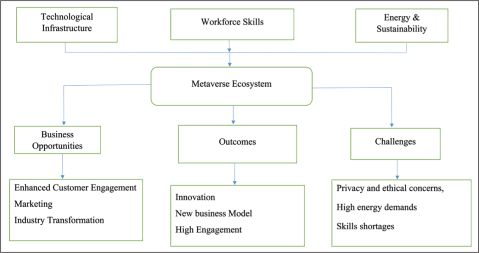
To address the identified integration gap, this study proposes the Metaverse Ecosystem Model (Figure 1). The framework is connected with the views of the literature and provides a structured lens for understanding how foundational inputs shape business outcomes.
Figure 1. The Metaverse Ecosystem Model.
Source: Authors own work.
The model operates in three logical layers:
This framework goes further than previous models in making sustainability and skills coequal pillars and causally linked to results, and making them available to managers as a diagnostic and strategic instrument.
Applications of the Metaverse in Business and Management
The metaverse has describes to be an imaginary technology but a realistic platform that is changing the fundamental operations in the business and management sectors. It facilitates value-generating, persistent, avatar-driven virtual worlds that are XR-powered, AI-enabled, blockchain-based, and digital twin-enabled to generate immersive, interoperable spaces that transcend conventional digital tools (Vig, 2023; Zhang et al., 2022). They are applied in marketing, operations, manufacturing, education and internationalisation, showing significant improvements in engagement, efficiency and innovation and revealing the complexity of implementation that requires an ecosystem approach. The metaverse in marketing acts as a unique Web3 channel, which outperforms Web 2.0 social media. Companies use immersive brand experiences, virtual showrooms, NFT loyalty programmes, and real-time co-creation events to create more emotional appeals and personalisation (Cheah & Shimul, 2023; Dwivedi et al., 2022). Furthermore, Adoption is supported by consumer research that shows that FOMO, self-extension and status-seeking become motivators as millennials seek to adopt a product that allows them to shift their passive advertising approach to active, embodied storytelling (Arghashi & Gunalay, 2025; Kaur et al., 2023). Moreover, in hospitality and tourism, 360__degreesign VR tours and virtual destinations can improve the overall customer experience, increase pre-trip interactions and post-trip retention, and contribute to sustainable tourism objectives (Foroudi et al., 2025).
Operations and supply-chain management represent another high-impact domain. Digital twins are used in metaverse platforms, which combine with IoT and real-time analytics, providing end-to-end visibility, predictive modelling, and automated decision-making (Zhang et al., 2025). Virtual warehouses are used to provide simulation-based optimisation by logistics firms in order to cut physical inventory costs and enhance traceability across global networks (Bhardwaj et al., 2025). These applications expedite the accelerate-enable-mobilise process based on dynamic capabilities, enabling managers to experiment with scenarios virtually before actual deployment.
The metaverse is used in the manufacturing industry to operationalise sustainable factories of the future. By using XR-enabled digital twins, AI-driven process optimisation, and circular-economy workflows, companies can attain resource efficiency, less downtime, and closed-loop material flows (Waehrens et al., 2026). A new frontier of application is business education and workforce development. Furthermore, Metaverse platforms are used by practitioners and universities in immersive training, Industry 4.0 simulation, and virtual apprenticeships to bridge theoretical and practical aspects (Rivas-Montoya et al., 2025). In developing countries, programmes like the proposed Metaverse Platform for Apprenticeship, Collaboration and Training (MPACT) can support the diffusion of tacit knowledge across borders, filling skills gaps in digital content production and virtual co-working (Ashalakshmy, 2025). Finally, SMEs apply the metaverse for internationalisation. Virtual storefronts and cross-border networking allow resource-constrained firms to enter into global markets at low costs, and to democratise opportunities previously accessible only to large multinationals (Martins & Barbosa, 2026).
Despite these advances, applications remain fragmented and pilot-heavy. Interoperability issues, high energy demands, privacy concerns, and flat infrastructure—especially in emerging regions constrain scalability (Kumar et al., 2025; Pagani & El Sawy, 2026). Such constraints examine the fundamentals of a comprehensive ecosystem model that can interrelate with technological infrastructure, workforce capabilities, and sustainability with strategic results. Furthermore, the use of the metaverse in business and management shapes better customer interaction, business efficiency, sustainable innovation, and growth that is inclusive growth. However, to make its full potential, it is essential to shift beyond individual implementations towards a more holistic, ecosystem-oriented approach.
Challenges and Opportunities of the Metaverse in Business and Management
Despite the transformative opportunities presented by the metaverse in marketing, operations, and education, the implementation of the metaverse in business and management is conditioned by the interdependent nature of opportunities and challenges. These dimensions are based on the literature and the practical implementations that have been discussed above. This is a forward-looking, detailed analysis, combining technological, organisational, economic, social, and environmental views, and strategic insight into sustainable adoption and implementation.
Opportunities
The metaverse offers new ways of doing business that cross conventional limits. Blockchain-based virtual economies and NFTs allow organisations to convert digital assets in a way never before conceivable—generating revenue in the form of a constant stream of revenue through virtual real estate, brand experiences and avatar customisation (Koohang et al., 2023). For management, it means hyper-personalised customer experiences in which avatar history, movement and real-time emotional reaction data are ingested into AI analytics to give predictive insights that are much better than a traditional CRM platform. The metaverse enables seamless cross-border collaboration in global operations: distributed teams can meet in shared virtual workspaces that make them feel as if in the real world, eliminating the need to travel up to 80% and shortening their decision-making time (Martins & Barbosa, 2026).
The developing technologies will benefit the whole world. The proposed MPACT is a vivid example of how tacit knowledge can be diffused to other continents, providing SMEs with access to global talent pools and experience without physical relocation (Ashalakshmy, 2025). Digital twins in metaverse settings in supply-chain management allow stress-testing of complete networks through various disruption conditions, including geopolitical, climatic or pandemic-related conditions, to improve resilience and circular material flows without physical resource consumption (Waehrens et al., 2026; Zhang et al., 2025). Sustainability appears as a strategic differentiator: virtual prototyping and training reduce physical waste and carbon emissions, while immersive consumer experiences encourage low-impact tourism and retail models (Foroudi et al., 2025). Overall, these opportunities foster innovation, democratise market access, and position forward-thinking organisations to capture first-mover benefits in the Web3 economy.
Challenges
The barriers discourage the understanding of these opportunities. The most unfavourable barrier is technical interoperability. The existing platforms employ where avatars, assets and data cannot easily move between ecosystems, which results in breaking the user experiences (Pagani & El Sawy, 2026). Critical review points to blockchain technology in a decentralised metaverse and Web 3.0 tech, specifically on security, privacy, and governance of both, besides scalability (Mohammed et al., 2026). Lead time in real interactions, high-bandwidth requirements, and device compatibility further limit accessibility, particularly in regions with uneven 5G/6G infrastructure.
At the organisational level, there are still great skills gaps. In addition to fundamental digital literacy, managers and employees will need more specific skills related to the production of immersive content, virtual governance, and ethical AI moderation, which are at present rare even in advanced markets (Bhardwaj et al., 2025; Rivas-Montoya et al., 2025). The cultural fears of job displacement and psychological imperatives of avatar-mediated work, such as identity fragmentation and the digital fatigue that becomes metaverse exhaustion, contribute to resistance to change. There is uncertainty about the value of money. Enterprise-level metaverse platforms are prohibitive in terms of development costs, and the unpredictability of cryptocurrencies and NFT markets may pose financial risk to SMEs (Kumar et al., 2025). Regulatory ambiguity compounds this: questions of intellectual property rights in virtual creations, taxation of cross-border digital transactions, and liability for harms occurring in decentralised spaces lack global consensus.
Uncertainty exists in the return on investment economically. Enterprise-level metaverse system development is prohibitive to SMEs, and cryptocurrency volatility and market changes in NFTs pose financial risk. This is compounded by the issue of regulatory ambiguity: The issue of intellectual property rights to virtual creations, taxation of cross-border digital transactions and liability for harms in decentralised spaces are not globally agreed upon (Arghashi & Gunalay, 2025). The metaverse presents particular cybersecurity risks, including avatar, virtual assets, and manipulation with effect, which require new governance frameworks altogether. In addition, the metaverse is a promising vision of improved innovation, operational efficiency, and inclusivity. Its effective implementation, however, will be determined by the active reduction of various key difficulties, such as interoperability constraints, employee skills, regulatory ambiguities, ethical considerations, and environmental impacts. These problems are all intertwined, and they cannot be dealt with satisfactorily independently. Moreover, the article proposes a comprehensive ecosystem approach, as discussed in the next section, to incorporate the technological infrastructure, human capital development and sustainability priorities with the overall strategic business goals. Organisations must align their systems in such a way as to be able to turn the potential of the metaverse into a sustainable competitive advantage.
Future of the Metaverse in Business and Management
The metaverse is the future of business and management infrastructure by 2030, leading to the transformation of current experimental systems into a seamless, boundaryless layer that connects physical operations, digital economies and human cooperation at scale. With the maturity of Web3 technologies, including interoperable standards, advanced AI agents, and energy-efficient XR devices, the metaverse will cease to be an activity of isolated pilots and become a constantly on ecosystem that redefines the organisational design, strategic decision-making, and value creation (Pagani & El Sawy, 2026; Waehrens et al., 2026). Furthermore, the future of marketing is hyper-embodied, predictive engagement. Avatars will be used as a consistent digital identity that transfers consumer preferences, behavioural histories and emotional profiles across platforms, allowing brands to provide context-aware experiences in real-time. Virtual world-building will be automated by generative AI, enabling SMEs to create pop-up metaverse campaigns with a small amount of capital. This will be expedited by generational changes: with Gen Z and Alpha as the primary consumers, the self-extension tendencies of FOMO will be normalised as immersive commerce, and virtual showrooms will become the main source of revenue, making traditional e-commerce a secondary source (Arghashi & Gunalay, 2025; Kumar et al., 2025).
Management and organisational structures will undergo profound decentralisation. Traditional hierarchies will give way to DAO-style governance models embedded within metaverse environments, where decisions are executed via smart contracts and real-time stakeholder voting (Ashalakshmy, 2025). Leadership will require new competencies, virtual presence literacy, ethical avatar governance, and ecosystem orchestration, transforming the C-suite into ‘metaverse strategists’ who balance physical and digital operations. Operations and supply-chain management will achieve near-autonomous intelligence. Moreover, Digital twins will evolve into living, self-optimising entities that simulate, predict, and adjust entire value networks instantaneously, incorporating climate variables, geopolitical risks, and circular-economy loops in real-time (Bhardwaj et al., 2025; Zhang et al., 2025). However, Industrial metaverse applications will deliver zero-waste factories where XR-guided maintenance and AI-orchestrated production minimise downtime and material use, directly supporting net-zero targets (Waehrens et al., 2026).
Sustainability will be transformed into a competitive advantage. Blockchain protocols and data centres that use less energy, carbon-conscious rendering and immersive experiences will reduce the environmental footprint, and conscious consumption and virtual tourism will reduce the emissions of physical travel (Foroudi et al., 2025). Emerging economies will leapfrog legacy infrastructure, using metaverse platforms to build inclusive digital economies that close skills and opportunity gaps (Martins & Barbosa, 2026). This study suggests the Metaverse Ecosystem Model, which provides the strategic roadmap to this future. With the integration of technological infrastructure, workforce skills, and energy and sustainability as equal pillars, organisations are able to systematically transform opportunities into innovation, new business models, and high engagement, and actively manage constraints. Standards of interoperability, harmonisation of regulations, and ethical frameworks will become important facilitators within the next 5 years. In the end, the metaverse will not replace business, but it will augment and replace it to the point of establishing hybrid realities in which competitive advantage goes to those who are able to achieve ecosystem orchestration. Furthermore, Investors in the Web3 economy today are the winners of tomorrow by investing in the three pillars of the Web3 economy. Future empirical studies confirming the ecosystem model in sectors and geographies will be necessary to facilitate this transition in a responsible and inclusive manner.
Limitations and Future Research Direction
This is a purely conceptual study and is, as such, limited in a number of ways. Being a synthesis of the existing literature instead of an empirical study, the suggested Metaverse Ecosystem Model has not been tested in the real-world organisational context yet. Although technological infrastructure, workforce skills, and energy and sustainability are integrated as coequal pillars in the model, the causal pathways and outcome relationships are logically derived from the literature; therefore, the practical predictive capability of the framework is not yet established. These restrictions would lead directly to some of the potential future research directions. A major limitation is the inadequacy of empirical research to validate and optimise the Metaverse Ecosystem Model in various industries and companies of different sizes. Moreover, there is a lack of longitudinal data to determine the long-term effects of innovation, circularity, resilience, and stakeholder value (Gursoy et al., 2023). Second, future work should examine the co-creation of metaverse purchase experiences in greater depth.
Although the Gursoy et al. (2023) findings indicate that most studies are limited to interaction-based co-creation, empirical studies are needed to learn how avatars, service providers, AI agents, and stakeholders influence the entire purchase process, including the awareness stage through post-consumption evaluation. These studies would provide real evidence on whether the pathways in the ecosystem model are valid in the contexts of B2B, B2C, and industrial. Third, the experiences of phygital, where there is a smooth transition between physical and virtual worlds, are an essential unexplored field. The researchers are supposed to explore the moderating effect of these hybrid offerings on hedonic and functional consumption motives and perceived risk, brand engagement, and willingness to pay, particularly in SMEs and emerging economies (Ashalakshmy, 2025; Gursoy et al., 2023). Fourth, stakeholder-level implications deserve rigorous examination.
Future research must also be used to test the propositions of the model on increased trust, employee training, decreased capital expenditure, and cross-stakeholder cooperation, especially in logistics, production, and emerging-market environments, where interoperability and skills gaps are acute (Gursoy et al., 2023; Waehrens et al., 2026). Finally, issues such as interoperability, energy use, digital divides, and ethical governance need to be tackled by interdisciplinary studies that integrate business, information systems, and sustainability approaches. Cost-effective, inclusive implementation pathways and scalable governance models can be tested through experimental and simulation-based research. The solution of these directions will transform the metaverse as a conceptual promise into a strategically mature area, allowing scholars and practitioners to explore its full transformative business and management potential.
Conclusion and Implications
The aim of this study was to propose an integrated ecosystem framework and articulate clear implications, thereby fulfilling its research objectives. The framework adds a new multilevel lens that cuts across the marketing, operations, and sustainability literatures. It also changes the emphasis on individual applications to systemic dependencies, providing a basis to further theory-building in business research of the Web3 era. Besides, managers are also encouraged to focus on balanced investment, covering the three pillars, to audit technological readiness, invest in workforce metaverse literacy programmes and incorporate circular-economy metrics at the very beginning. In addition, they are also encouraged to market the engagement pathway to develop immersive campaigns that will adequately appeal to Millennials and Generation Z consumers. Marketers in emerging economies are advised to use this model to come up with inclusive digital infrastructure and focused training programmes (Ashalakshmy, 2025). This research enables its audience to respond to the dynamics of the metaverse by organising knowledge into a coherent ecosystem framework that gives scholars and practitioners a strategic viewpoint on their opportunities and constraints. Moreover, subsequent studies need to aim at empirically confirming the proposed framework in different industries and geographical settings to strengthen its explanatory and predictive capabilities.
Acknowledgement
The authors gratefully acknowledges the financial support provided by the Indian Council of Social Science Research (ICSSR). The author would like to express sincere gratitude to the faculty members and fellow researchers of the department/institution for their valuable guidance, constructive suggestions, and continuous academic support throughout the course of this research. The author deeply appreciates their time, expertise, and support. The author also acknowledges all those who directly or indirectly contributed to the successful completion of this research.
Declaration of Conflicting Interests
The authors declared no potential conflicts of interest with respect to the research, authorship and/or publication of this article.
Funding
The authors disclosed receipt of the following financial support for the research, authorship and/or publication of this article: This research was supported by the Indian Council of Social Science Research (ICSSR) through the ICSSR Doctoral Fellowship. The study was carried out during the fellowship period. The funding agency had no role in the design of the study, data collection, analysis, interpretation of data, or writing of the manuscript.
ORCID iD
Sachin Kumar https://orcid.org/0009-0005-4104-7715
Arghashi, V., Kumar, H., Venkatesh, U., Mathew, J., & Farina, .png) . A. (2025). B2B marketing in metaverse: Toward a theoretical framework. Journal of Business & Industrial Marketing, 41(2), 232–254. https://doi.org/10.1108/jbim-09-2024-0679
. A. (2025). B2B marketing in metaverse: Toward a theoretical framework. Journal of Business & Industrial Marketing, 41(2), 232–254. https://doi.org/10.1108/jbim-09-2024-0679
Ashalakshmy. (2025). Exploring trends and prospects of metaverse in emerging economies. European Journal of Management Studies, 31(1), 3–22. https://doi.org/10.1108/ejms-06-2025-0069
Bhardwaj, S., Mahapatra, D., & Behl, A. (2025). Examining managerial challenges in metaverse adoption in logistics and supply chain: A case-based investigation from a dynamic capability lens. The International Journal of Logistics Management, 37(1), 157–184. https://doi.org/10.1108/ijlm-08-2024-0478
Cheah, I., & Shimul, A. S. (2023). Marketing in the metaverse: Moving forward—What’s next? Journal of Global Scholars of Marketing Science, 33(1), 1–10. https://doi.org/ 10.1080/21639159.2022.2163908
Dwivedi, Y. K., Hughes, L., Wang, Y., Alalwan, A. A., Ahn, S. J., Balakrishnan, J., Barta, S., Belk, R., Buhalis, D., Dutot, V., Felix, R., Filieri, R., Flavián, C., Gustafsson, A., Hinsch, C., Hollensen, S., Jain, V., Kim, J., Krishen, A. S., … Wirtz, J. (2022). Metaverse marketing: How the metaverse will shape the future of consumer research and practice. Psychology & Marketing, 40(4), 750–776. https://doi.org/10.1002/mar.21767
Firmansyah, E. A., & Umar, U. H. (2023). Metaverse in business research: A systematic literature review. Cogent Business & Management, 10(2). https://doi.org/10.1080/23311975.2023.2222499
Foroudi, P., Marvi, R., & Zha, D. (2025). Immersive currents and futures: Mapping the metaverse in contemporary hospitality and tourism research. International Journal of Contemporary Hospitality Management, 38(1), 186–209. https://doi.org/10.1108/ijchm-03-2025-0363
Gursoy, D., Lu, L., Nunkoo, R., & Deng, D. (2023). Metaverse in services marketing: An overview and future research directions. Service Industries Journal, 43(15–16), 1140–1172. https://doi.org/10.1080/02642069.2023.2252750
Huang, S., Luo, H., Zheng, P., Ma, N., Chen, J., Mo, G., Jing, S., Wang, G., & Yan, Y. (2023). Towards industrial metaverse: Opportunities and challenges. Journal of Advanced Manufacturing Science and Technology, 3(4), 2023011. https://doi.org/10.51393/j.jamst.2023011
Kaur, J., Mogaji, E., Paliwal, M., Jha, S., Agarwal, S., & Mogaji, S. A. (2023). Consumer behavior in the metaverse. Journal of Consumer Behaviour, 23(4), 1720–1738. https://doi.org/10.1002/cb.2298
Khatri, M. (2022). Revamping the marketing world with metaverse—The future of marketing. International Journal of Computer Applications, 184(29), 1–5. https://doi.org/10.5120/ijca2022922361
Koohang, A., Nord, J. H., Ooi, K.-B., Tan, G. W.-H., Al-Emran, M., Aw, E. C., Baabdullah, A. M., Buhalis, D., Cham, T., Dennis, C., Dutot, V., Dwivedi, Y. K., Hughes, L., Mogaji, E., Pandey, N., Phau, I., Raman, R., Sharma, A., Sigala, M., … Wong, L. (2023). Shaping the metaverse into reality: A holistic multidisciplinary understanding of opportunities, challenges, and avenues for future investigation. Journal of Computer Information Systems, 63(3), 735–765. https://doi.org/10.1080/08874417.2023.2165197
Kumar, R., Aneja, P., Jadaun, R., Kiran, P. B. N., Saxena, N., Saxena, S., Singh, P. K., & Painoli, A. K. (2025). Metaverse marketing: A review and future research agenda. Information Discovery and Delivery, 54(1), 35–49. https://doi.org/10.1108/idd-05-2024-0066
Martins, R., & Barbosa, B. (2026). The role of the metaverse in the internationalization of small and medium-sized enterprises. Journal of Small Business & Entrepreneurship, 38(1), 61–89. https://doi.org/10.1080/08276331.2025.2544102
Meepung, T., & Kannikar, P. (2022). Metaverse: Virtual world challenges and opportunities for digital business. Journal of Economics, Business and Management, 10(4), 277–282. https://doi.org/10.18178/joebm.2022.10.4.712
Mohammed, F. H., Izham, I. A., Akbar, M. J., Ansar, N. S. M., Roslan, N. M., Zainuddin, A. A., & Ahmad, H. K. (2026). Balancing innovation and privacy in the decentralized metaverse: Case studies exploring blockchain and Web 3.0 for sustainable development. International Journal on Perceptive and Cognitive Computing, 12(1). https://doi.org/10.31436/ijpcc.v12i1.534
Pagani, M., & El Sawy, O. A. (2026). Challenges of boundaryless metaverses: Implications for IS research. European Journal of Information Systems, 1–19. https://doi.org/10.1080/0960085x.2025.2612487
Periyasami, S., & Periyasamy, A. P. (2022). Metaverse as a future promising platform business model: Case study on fashion value chain. Businesses, 2(4), 527–545. https://doi.org/10.3390/businesses2040033
Piñeiro-Chousa, J., López-Cabarcos, M. Á., Vittori-Romero, V., & Pérez-Pérez, A. (2024). Evolution and trends of the metaverse in business and management: A bibliometric analysis. Review of Managerial Science, 19(1), 197–222. https://doi.org/10.1007/s11846-024-00741-5
Rathore, B. (2018). Metaverse marketing: Novel challenges, opportunities, and strategic approaches. Eduzone International Peer Reviewed/Refereed Academic Multidisciplinary Journal, 7(2), 72–82. https://doi.org/10.56614/eiprmj.v7i2y18.344
Varriale, V., Cammarano, A., Michelino, F., & Caputo, M. (2024). Exploring the environmental, economic, and social implications of metaverse adoption in business and management. European Management Journal, 43(6), 945–957. https://doi.org/10.1016/j.emj.2024.09.007
Vasist, P. N., Krishnan, S., & Bose, I. (2025). Navigating ethical concerns in the metaverse: An integrative review and an agenda for future research. Internet Research, 36(7), 43–62. https://doi.org/10.1108/intr-04-2024-0657
Vig, S. (2023). Preparing for the new paradigm of business: The metaverse. Foresight-Russia, 17(3), 6–18. https://doi.org/10.17323/2500-2597.2023.3.6.18
Waehrens, B. V., Berger, U., Dueholm, B. C., Lassen, A. H., & Madsen, O. (2026). Operationalizing the industrial metaverse: Strategies, challenges, and opportunities for the sustainable factory of the future. Sustainability, 18(6), 2941. https://doi.org/10.3390/su18062941
Weinberger, M., & Holl, T. (2025). Metaverse business mechanisms from an intellectual capital perspective. Journal of Intellectual Capital, 27(2), 372–392. https://doi.org/10.1108/jic-02-2025-0049
Zhang, D., Chadwick, S., & Liu, L. (2022). The metaverse: Opportunities and challenges for marketing in Web3. SSRN Electronic Journal. https://doi.org/10.2139/ssrn.4278498
Zhang, Z., Wu, H., Qiu, Y., Liao, Z., & Song, M. (2025). Metaverse for logistics and supply chain management: New framework and research advances. The International Journal of Logistics Management, 37(1), 42–67. https://doi.org/10.1108/ijlm-07-2024-0461
